
Share article via:
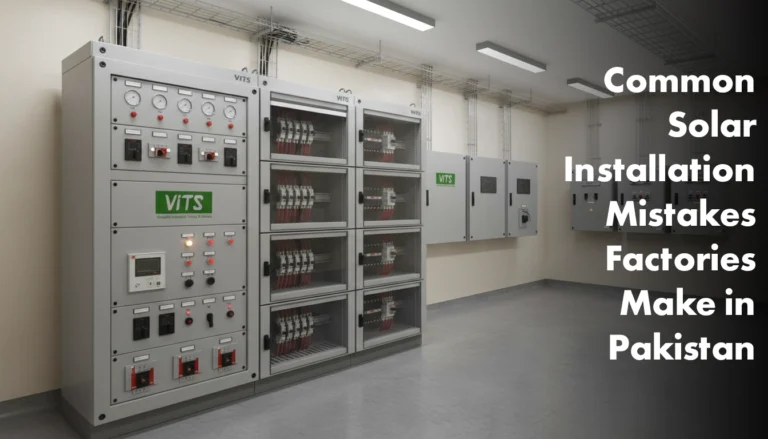
Most industrial solar failures in Pakistan do not happen because solar is unreliable.
They happen because factories make preventable decisions before installation even starts.
Wrong installers.
Wrong system type.
Wrong assumptions about load, batteries, and protection.
This article exposes the real mistakes factories make and how to avoid turning a multi-million-rupee investment into a liability.
Industrial solar is not residential solar scaled up.
Factories operate:
Solar systems that ignore this reality fail fast.
Most failures trace back to design shortcuts, not equipment quality.
This is the most common and most expensive mistake.
Factories often:
Low-price installers cut costs by:
Cheap systems do not fail immediately.
They fail slowly, during peak demand or outages.
If price is your only filter, you are inviting downtime.
Professional EPC execution avoids this risk:
https://vits.com.pk
Installing solar without an energy audit is blind decision-making.
An audit reveals:
Without this data:
Factories that skip audits usually overspend later on corrections.
Energy audit services exist for a reason:
https://vits.com.pk/our-solutions/energy-audit/
Many factories choose systems emotionally.
On-grid systems shut down during load shedding.
Hybrid systems need correct battery sizing.
Off-grid systems require serious investment.
Common mistake:
Choosing on-grid solar for 24/7 operations.
This causes:
System choice must match operational reality, not brochure promises.
Learn system options here:
https://vits.com.pk/vits-solar-calculator/
This mistake hides well.
Symptoms include:
Installers undersize systems to reduce quote prices.
Factories then:
Industrial solar must be designed for worst-case conditions, not averages.
Load shedding in Pakistan is not uniform.
It varies by:
Designs that ignore this fail in real life.
During outages:
A solar design must simulate actual grid behavior, not ideal scenarios.
Many hybrid systems only look good on paper.
Common battery mistakes:
Result:
Hybrid solar is only effective when batteries are designed strategically.
This mistake is dangerous.
Inadequate protection leads to:
Factories require:
Solar without industrial-grade switchgear is unsafe.
Reactive power silently kills savings.
Without PFI plants:
Many factories install solar but ignore the power factor.
That is a half-solution.
Integrated energy optimization delivers real ROI.
Net metering is not automatic.
Common issues:
Delays can last months.
During this time:
Professional handling avoids this mess.
Solar is not install-and-forget.
Without monitoring:
Factories need:
After-sales support defines system lifespan.
Local installers sell panels.
EPC companies deliver systems.
EPC execution includes:
This difference determines whether your solar project succeeds or fails.
Key Takeaways for Factory Owners
Solar is not just about savings.
It is about reliability, safety, and continuity.
If you are planning an industrial solar project, do not rush.
Evaluate:
Make decisions based on engineering, not sales talk.
Start with a professional assessment:
https://vits.com.pk