
Share article via:
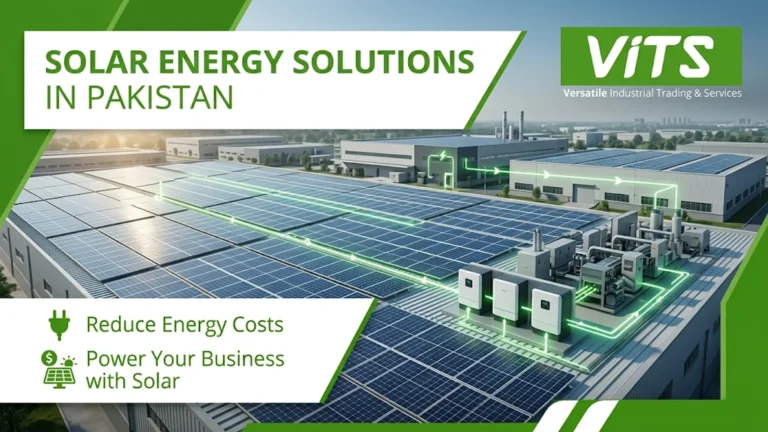
Electricity prices in Pakistan continue to rise, putting pressure on households, commercial facilities, and industrial operations. As a result, many organizations in Pakistan are turning to solar energy solutions to reduce operating costs, improve energy reliability, and support sustainability goals.
Modern solar technology has become more affordable, efficient, and accessible than ever before. Whether you operate a manufacturing plant, commercial building, warehouse, or office complex, solar energy can provide long-term financial and environmental benefits.
Solar energy solutions in Pakistan refer to systems that convert sunlight into electricity using photovoltaic (PV) panels, inverters, and supporting equipment. These solutions help homes and businesses reduce dependence on the national grid while lowering electricity costs and carbon emissions.
Pakistan receives abundant sunlight throughout the year, making solar energy one of the most practical renewable energy sources available.
Several factors are driving the rapid adoption of solar energy:
Industries particularly benefit because energy expenses often represent a significant portion of operational costs.
On-grid systems are connected directly to the utility grid.
Benefits include:
These systems are ideal for businesses with stable grid access.
Hybrid systems combine solar panels, battery storage, and grid connectivity.
Advantages include:
Many industrial facilities choose hybrid systems to maintain critical operations.
You can also use our Solar Load Calculator to find the best solar solution according to your needs.
Off-grid systems operate independently from the utility network.
Best suited for:
Although the initial investment may be higher, they provide complete energy independence.
Solar systems can dramatically reduce monthly electricity expenses, especially for commercial and industrial consumers.
Businesses become less vulnerable to grid disruptions and tariff increases.
Solar power generates electricity without producing harmful emissions, helping organizations reduce their environmental footprint.
Most quality solar systems operate efficiently for 25 years or more, providing long-term savings.
Buildings equipped with solar installations often command higher market values and attract environmentally conscious buyers.
Pakistan’s industrial sector is increasingly adopting solar technology to improve efficiency and competitiveness.
Common applications include:
According to the VITS company profile, the company provides industrial and commercial solar power plants, energy management solutions, switchgear manufacturing, and turnkey electrical engineering services across Pakistan.
Net metering allows solar system owners to export excess electricity back to the utility grid.
Process
This mechanism significantly improves the financial return of solar investments.
| Feature | On-Grid | Hybrid | Off-Grid |
|---|---|---|---|
| Grid Connection | Yes | Yes | No |
| Battery Storage | No | Yes | Yes |
| Backup During Outage | No | Yes | Yes |
| Initial Cost | Low | Medium | High |
| Maintenance | Low | Medium | Medium |
| Best For | Cities | Businesses | Remote Areas |
Before selecting a solar solution, evaluate:
A professional energy audit can help determine the optimal system size and expected savings.
VITS (Versatile Industrial Trading & Services) specializes in industrial and commercial solar power systems, energy audits, switchgear manufacturing, and electrical engineering solutions. The company provides turnkey services covering design, supply, installation, commissioning, and after-sales support.
Key strengths include:
Key Takeaways
Common Mistakes
Pro Tips
As electricity costs continue to rise, solar energy solutions in Pakistan provide a practical and sustainable path toward energy independence. Whether for industrial facilities, commercial buildings, or large-scale operations, solar technology offers measurable savings, environmental benefits, and long-term value.
Organizations looking to maximize energy efficiency should partner with experienced providers capable of delivering complete design, installation, commissioning, and maintenance services.
For businesses seeking reliable solar expertise, VITS offers turnkey solar and electrical engineering solutions tailored to Pakistan’s industrial and commercial sectors.
What is the best solar system type for businesses in Pakistan?
Most businesses prefer on-grid or hybrid systems. On-grid systems offer maximum savings through net metering, while hybrid systems provide backup power during outages.
How much can solar energy reduce electricity bills?
Savings vary by consumption and system size. Many commercial and industrial users can reduce electricity costs by 50% to 90% after installing a properly designed solar system.
Is net metering available in Pakistan?
Yes. Eligible consumers can apply for net metering and receive credits for excess electricity exported to the grid, subject to regulatory requirements.
How long do solar panels last?
High-quality solar panels typically perform effectively for 25 to 30 years with minimal degradation when properly maintained.
Are solar systems suitable for industrial facilities?
Yes. Industrial facilities often achieve the highest return on investment because of their large energy consumption and daytime operational schedules.